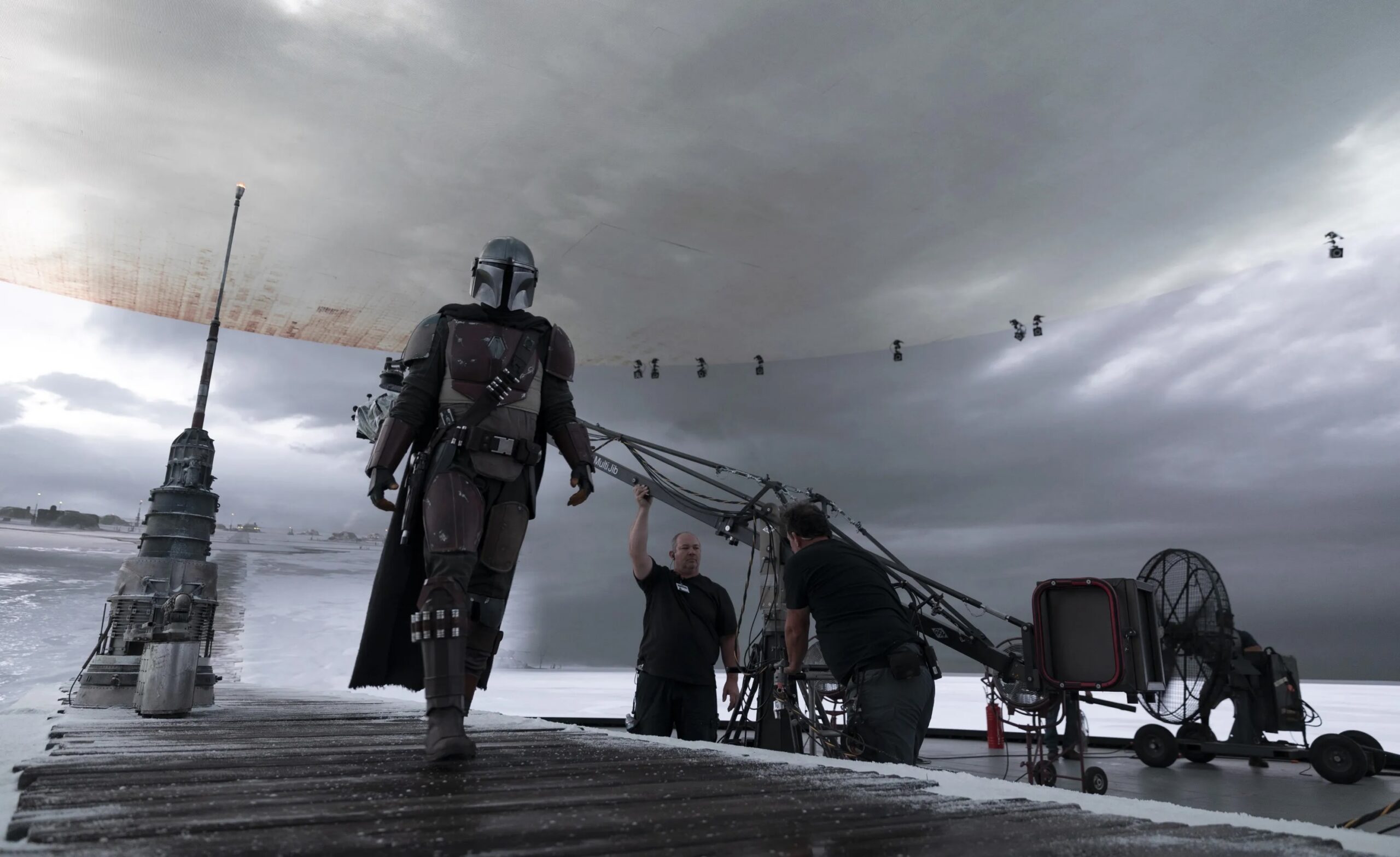
Proximity: A New Model for Creative Education
South Africa’s creative industries face a well-documented crisis of misalignment: graduates emerge from universities with theoretical knowledge but insufficient practical capability, while industry struggles to find workers with production-ready skills. The gap between the classroom and the set has become a structural problem.
The DeepSouth initiative is built on a simple premise: the most effective way to close that gap is to eliminate the physical and institutional distance between education and industry altogether.
We call this proximity — the deliberate co-location of commercial production and academic education within the same facility, on the same projects, in the same rooms. Not industry visits. Not guest lectures or master-classes. Not internships arranged after graduation. Students and working professionals occupy the same studio, on live productions, from the earliest stages of training.
What Proximity Produces
When commercial production and education share a single facility, several things become structurally possible that no amount of curriculum redesign can achieve on its own:
| Students Meet Employers Before They Graduate In a conventional model, students complete their studies and then begin looking for work. In a proximity model, students work alongside industry professionals on commercial projects as part of their training. By the time they graduate, they have already been seen, assessed, and — in many cases — hired by the people who will employ them. | Industry Shapes Curriculum in Real Time When commercial clients are booking the same facility where students train, the skills the industry actually needs become immediately visible. Curriculum doesn’t lag behind industry by three to five years — it adjusts continuously, because educators and practitioners are in daily contact. |
| Commercial Revenue Sustains the Educational Mission The studio generates third-stream income through commercial bookings. This revenue funds operations, equipment upgrades, and bursaries — reducing dependence on tuition fees and government subsidy alone. Education becomes financially self-reinforcing rather than perpetually grant-dependent. | The Facility Never Sits Idle University facilities are notoriously underutilised — empty during holidays, evenings, and weekends. A dual-purpose studio fills those gaps with commercial bookings. The same equipment and infrastructure serves both educational and commercial clients, maximising the return on every rand of capital investment. |
Production-Integrated Learning
The most valuable educational experience the proximity model enables is production-integrated learning — structured participation in live commercial projects as a core component of the curriculum, not an optional extra.
This goes beyond conventional work-integrated learning (WIL) placements. In production-integrated learning, students don’t leave the university to visit industry — industry comes to the university. When a commercial production books the VP studio, student interns are embedded in the crew as a condition of the booking. They work under professional supervision on real deliverables with real deadlines.
The educational architecture is designed to make this mandatory rather than aspirational:
| For Students – Direct exposure to professional workflows, standards, and expectations. Portfolio-ready work produced under real production conditions. Professional networks built through working relationships, not networking events. | For Industry – Access to a trained, supervised workforce at reduced cost. A direct pipeline for talent recruitment — the studio becomes an extended audition. Active participation in shaping the next generation of professionals. | For the University – Demonstrable graduate employability outcomes. Authentic work-integrated learning that satisfies accreditation requirements. A living laboratory that keeps academic programmes current and credible. |
The Creative Playground
Virtual production moves beyond just ‘training students for industry’ — it fundamentally transforms what is possible in terms of creative research.
Consider the economics of traditional filmmaking for a postgraduate student. You want to set your film in a vast desert landscape, or a futuristic cityscape, or the interior of a building that is inaccesible or no longer exists? You need locations, transport, permits, construction, set dressing — all of which cost money that student filmmakers simply do not have. The ambition of the work is constrained by the budget available, transport, access to spaces . These hard contraints limits creative possibility.
A VP studio inverts this equation entirely.
The complexity of the worlds students can create is bounded only by the time they invest in building them — not by cost.
A student willing to spend six months developing an intricate virtual environment can produce imagery of extraordinary production value with almost no financial outlay. The LED volume, the game engine, the rendering pipeline — these are shared infrastructure. The creative labour is the student’s own. The result is work that would be indistinguishable from a production with a budget orders of magnitude larger.
This is not merely a convenience. It represents a qualitative shift in what postgraduate creative research can achieve:
| New Knowledge Through Practice When the financial barrier to ambitious production is removed, creative practice-as-research can operate at a level of visual and narrative complexity previously reserved for funded productions. Masters and doctoral candidates can pursue research questions that require elaborate world-building without requiring elaborate budgets. | Democratising Production Value South African stories deserve to be told with the same visual richness as any other. A student filmmaker in Johannesburg or Cape Town, with access to a VP studio, can create work that competes visually with productions from anywhere in the world. The playing field doesn’t just level — it tilts in favour of those with the most compelling stories and the most dedicated craft. |
The VP studio as creative playground is, in essence, a research infrastructure — an environment where the imagination is the only scarce resource.
Global Context: How Others Are Doing It
The proximity model is not theoretical. Institutions around the world are already integrating commercial VP production with education and research — each with a different emphasis, but all converging on the same insight: that the old separation between campus and industry is no longer viable.
Examples of different approaches to educational-commercial partnerships, sometimes involving different forms of public-private partnerships and configurations are explored in some detail here.
Below is one shining example of how things are being done in Scotland.
CoSTAR Realtime Lab — Edinburgh & Dundee, Scotland
A £9 million component of the UK’s £75.6 million CoSTAR network — the largest public investment in creative industries R&D ever made in the UK.
Led by Abertay University and the University of Edinburgh, with commercial partners including Chroma Developments and CodeBase. Studios are distributed across university and commercial sites, connected via a cloud-based collaboration platform. The programme has already engaged over 1,100 companies and upskilled 800+ people, with nearly £100 million in private co-investment attracted on top of public funding.
Takeout: Public infrastructure investment in VP generates massive private leverage — every £1 of public money attracted £1.30 in co-investment.
Educational Offerings (in development)
The initiative supports learning at every level, from foundational technical skills to advanced creative research to professional industry certification.
| Undergraduate Integration – VP skills embedded within existing film, television, and digital arts production courses. Cross-disciplinary access for students in architecture, engineering, game design, and performing arts. Foundational literacy in real-time rendering, LED volume operation, and virtual art direction. | Postgraduate Research – Honours, Masters, and PhD creative practice-as-research supported by VP infrastructure. The creative playground in action — students pursuing ambitious world-building and visual storytelling unconstrained by production budgets. AI-augmented filmmaking workflows as emerging research territory. | Industry Short Courses – Micro-credential certification programmes for working professionals. Targeted modules in Unreal Engine for film, camera tracking and calibration, virtual art direction, AI-assisted VFX, and LED volume operation. Delivered through Wits Plus and institutional partners as professional development offerings. |
VP Certificate Programme (proposed Wits Plus Course) — 160 Hours
The flagship short course provides an overview of the VP domain/terrain, while alsp offering: a comprehensive introduction to distinct but interrelated virtual production competencies across eight modules. This is designed for both emerging professionals and experienced crew transitioning into VP workflows.
| 1 | Introduction to Virtual Production History, evolution, and current state of VP technology. Overview of ICVFX, LED volumes, and real-time rendering. Industry landscape and career pathways. |
| 2 | Unreal Engine for Film Foundational skills in Unreal Engine 5 for cinematic production. Asset creation, lighting, and virtual set construction. Blueprint scripting for interactive environments. |
| 3 | Virtual Art Direction Translating production design into digital environments. Colour theory, spatial composition, and atmospheric design for LED volumes. Collaboration between physical and virtual art departments. |
| 4 | Camera Tracking & Calibration Camera tracking systems, lens calibration, and frustum management. Synchronising physical and virtual cameras for seamless perspective. Troubleshooting on-set technical challenges. |
| 5 | LED Volume Operation LED panel technology, configuration, and colour management. nDisplay setup and multi-cluster rendering. On-set operation, calibration, and maintenance. |
| 6 | Lighting for Virtual Production Integrating physical and virtual lighting. Interactive light from LED volumes. Practical techniques for matching CG and real-world illumination. |
| 7 | AI-Assisted VFX Workflows Emerging AI tools for compositing, rotoscoping, and environment generation. Integrating AI-generated content into VP pipelines. Ethical and creative implications of AI in production. |
| 8 | Production Management for VP Budgeting, scheduling, and crew management specific to VP shoots. Managing the intersection of physical and virtual departments. Client communication and delivery workflows. |
The certificate programme is designed as a modular offering. Individual modules may also be taken as standalone short courses for professionals seeking targeted upskilling in specific areas.
Programme Structure
VP Certificate Course — 160 Hours
Our foundational certificate is structured across eight specialised modules, designed to evolve into standalone micro-credential courses.
- 01
- Introduction to Virtual Production
- Foundations, workflows, and industry context
- 02
- Unreal Engine for VP
- Real-time rendering, asset creation, and world-building
- 03
- LED Volume Operations
- Hardware, calibration, colour science, and stage management
- 04
- Camera Tracking & Synchronisation
- Tracking systems, frustum management, and camera workflows
- 05
- AI-Augmented VFX
- AI compositing tools, generative imagery, and hybrid pipelines
- 06
- Virtual Art Direction
- Environment design, lighting for VP, and creative direction
- 07
- VP Production Management
- Planning, scheduling, and managing VP shoots
- 08
- Capstone Project
- Industry-integrated production exercise with professional mentors
Future Pathways
Short courses, degree integration, and professional development
This initial general-purpose VP certificate will evolve into separate, more detailed micro-credential courses — each corresponding to the module areas above. We are also developing curriculum for integration into existing Wits Film & Television degrees, and planning advanced masterclasses for industry professionals.